12" Audiopulse Hidden Home Theater Subwoofer Project
Start
2021 Update: I replaced this Audiopulse driver for a
Dayton Audio RSS315HF-4 12" Reference HF Subwoofer and couldn't be happier.
This driver is a drop-in replacement for this design and models perfectly
without changing the volume or the tuning frequency. I've currently got this sub
in my garage with a sort of makeshift home theater setup and it works perfecly.
It's being powered with an old Sony receiver at the moment pushing a modest 100
watts into this thing, but it sounds great. A better sub amp is in the works,
watching CL for something to pop up that's cheap. But since this Audiopulse
driver is no longer available, you can use the RSS315HF driver as a drop-in
replacement for this design and it works great. Can easily recommend.
Back to original post...
I’ve been a big fan of TC Sounds drivers for over 15 years.
They manufacture some of the beefiest, gnarliest high-excursion drivers and passive
radiators on the market. I was shocked to learn that they’ve filed for
bankruptcy in spite of having such a great reputation for amazing drivers not
only among the DIY crowd but as an OEM as well. I’m not exactly sure what
happened behind the scenes that would put them in such a situation. Their last
push was developing the Audiopulse brand which isn’t available from too many
places except one for now - Parts Express.
When I finally got around to thinking about building a sub for
my home theater, I checked out the specs on the EPIC 12″ dual 4-ohm driver, the
only one PE was carrying at the time, and decided it would be a perfect fit for
my small HT. Quick specs include 600W RMS power handling, 22mm xmax one-way
(over 2″ pk-pk mech. travel), voice coil leads stitched into the linear spiders,
140 oz. magnet, and a sweet black anodized single dish alloy cone. T/S
parameters make this sub suitable for either a vented or sealed enclosure. The
fairly high Vas (97 L) requires a large 4th order enclosure to achieve a
nominally flat response. I didn’t have room to make the box as big as the driver
would like, but ended up with a 95 L box that when tuned to 22 Hz would yield
only a slight +0.8 dB hump and and f3 of 21 Hz. Which is only slightly worse
than if the box were nearly 1.5 times that size.
The biggest compromise I made was choosing to use a single 4″
diameter port. Below 30 Hz, the port air speed arises well above the socially
acceptable level, but I just was not physically able to fit two 4″ ports in the
box when each one would have needed to be 38″ long to tune it to 22 Hz. And the volume that
the ports took up inside the box, took up precious volume I was trying to
conserve in order to reach the lowest extension possible with this design. I
knew the port noise would be audible, but I wasn’t too worried about it. In
practical terms, if the bass is thumping loud enough to make the air chuffing
out of the port audible, then chances are the rest of the speakers are also
loud enough to cover it up. While doing sine sweeps, the air noise is quite
apparent, but while actually watching a movie or listening to music, I didn’t hear it near as much.
Though if I had more room, I would have definitely opted for dual 4″ ports or a
single 6″ port.
For now I’m powering the sub with an old Techniques stereo
receiver I’ve had since I was 15 years old. It pushes a modest 80W per channel into 8
ohms. Since this is a dual coil 4 ohm sub I wired both
channels to each coil to get the most power possible out of this amp/driver
combo. I’m not too worried about cooking this 20 year-old antique. It would
give me an excuse to buya real subwoofer amp. I don’t know what the amp is
capable of pushing into 4 ohms, but it’s probably not much more than 100W per
channel, so I figure the sub is seeing around 200W total. Nowhere near the 600W
it can handle.
I ran some tests the other night with REW and did some in-room
FR plots. I was very happy, after building so many sealed subs recently, to see
the response nearly dead flat from 70 Hz all the way down to 20 Hz, before it
began rolling off, was very exciting. And wow, that thing plays deep, even
better than what it modeled like. The f3 was suppose to be around 21 Hz, instead
it’s more like 18 Hz in-room. Which for me and my modest family room is plenty.
I haven’t done any max SPL tests, I’ve been hesitant to do those kinds of tests
ever since I fried a brand new TC sounds driver years ago. But after watching
the into to Toy Story II (my favorite test DVD) this sub just shakes, rattles
and rolls the whole house. Even at only 200W. I can’t imagine what this thing
could sound like with 3x that much power. Well, mathematically, it should only
sound 4.77 dB louder, but that is still substantial amount of volume, and would
certainly be noticeable.
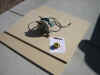
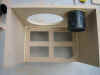
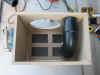
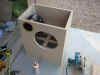
So check out some of the pictures of the build for this sub.
Even though it’s a somewhat compromised design as far as cubic volume and port
area go, it sounds absolutely fantastic and does not take up any room in my
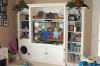
family room, as it’s completely integrated into the entertainment center. And I
know what you’re thinking, doesn’t the whole entertainment center just rattle?
Well, if I hadn’t build that whole entertainment center out of 3/4″ MDF and
glued and screwed every piece together, I might say yes, but the entertainment
center is as beefy as the sub is. So it’s quite solid and doesn’t rattle at all.
The best part is this sub gets a 10/10 for the Wife Acceptance Factor (WAF). She
is very happy that the sub is hidden into the furniture and is barely
noticeable. I have to agree, though I don’t mind big huge subs as much as she
does, I still tend to
shy away from anything that is overly cumbersome for the room. And this sub is
definitely not that. But it certainly knows how to fill the room with lots of
great-sounding, heart-pumping, movie-crunching bass.
EPIC Bookcase Subwoofer Specs:
- Audiopulse EPIC 12″ Subwoofer w/dual 4 ohm coils
- 95L Enclosure tuned to 22 Hz
- 4″ PVC port 17.5″ long with 6″ flare
- Flush-mounted driver with 1.5″ thick front baffle
- Made from 3/4″ MDF
- 20-3/8″ x 26-5/8″x 15″ (WxHxD)
- Flat in-room response to 20 Hz
- -3 dB point 18 Hz
- 600W RMS capability
- Painted in Linen White to match entertainment center
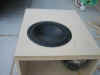
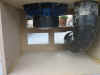
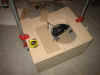
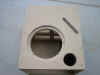
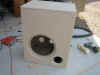
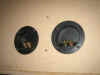
Check out the pictures below:











|


.JPG)

